
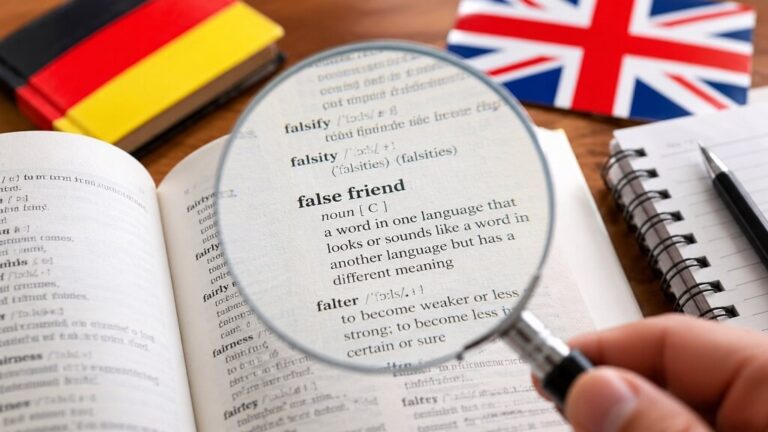
A German speaker who tells you “Ich habe ein Gift für dich” is not planning a nice surprise. They just warned you about poison. That single word has probably caused more awkward silences at German dinner tables than any other in the language, and it is the textbook example of what linguists call a false friend.
What Are False Friends, Exactly

False friends are words in two languages that look or sound almost identical but carry completely different meanings. The term comes from the French “faux amis,” first used in a 1928 book by linguists Maxime Koessler and Jules Derocquigny titled “Les Faux Amis, ou les Trahisons du Vocabulaire Anglais.” Their point was simple: a word that resembles one you already know can trick you into assuming you understand it when you do not.
German and English share a common ancestor, which is exactly why this happens so often. Both belong to the Germanic language family, so thousands of words evolved from the same roots. Over centuries, some of those words drifted apart in meaning while keeping a similar shape. The result is a language full of traps for anyone translating on instinct rather than checking the actual definition.
This is not just a beginner’s problem. False friends show up in business emails, contracts, product descriptions, and marketing copy translated by people who are otherwise fluent. A single misread word can flip the meaning of a sentence, and in professional or legal contexts that mistake can be expensive.
Anyone handling German content at scale, whether for a website, a manual, or client correspondence, benefits from working with translators who know exactly where these traps sit. Elmura’s professional German translation services are built around catching precisely this kind of nuance before it reaches a client’s inbox.
Here are 15 of the most common German words that English speakers misread on sight.
15 German False Friends to Watch For
| German word | Looks like | Actually means |
| Gift | gift | poison |
| Rat | rat | advice, council |
| Mist | mist | manure, nonsense |
| Chef | chef | boss, manager |
| Bald | bald | soon |
| Brief | brief | letter |
| Fast | fast | almost |
| Gymnasium | gymnasium | secondary school |
| Kind | kind | child |
| Handy | handy | mobile phone |
| Rock | rock | skirt |
| Also | also | so, therefore |
| Bekommen | become | to receive |
| Sensibel | sensible | sensitive |
| Billion | billion | trillion |
Why These German False Friends Cause Confusion
A closer look at these words shows why they are so easy to misunderstand, even for people who already speak some German.
Gift

The most famous case. In German, das Gift means poison, and the correct word for a present is Geschenk. The connection is not random: the older Germanic root meant something “given,” and in some dialects that shifted specifically toward a dose given to someone, in the medical or lethal sense.
Rat

Der Rat means advice or a council, not the rodent. A Stadtrat is a city council. The rodent in German is die Ratte.
Mist
Der Mist means manure or, informally, nonsense. Complaining about “so ein Mist” has nothing to do with weather.
Chef
Der Chef is the boss or head of a department, not someone who cooks. The person running the kitchen is called a Koch.
Bald
As an adverb, bald means soon. It has nothing to do with hair. “Ich komme bald” means “I’m coming soon.”
Brief
Der Brief is a letter, the kind you post. Something short in German is kurz.
Fast
This one flips direction entirely. Fast in German means almost or nearly. Speed is described with schnell.
Gymnasium

Das Gymnasium is an academic secondary school that prepares students for university, part of the German tracked education system. A place to exercise is called a Fitnessstudio.
Kind
Das Kind simply means child. It has no connection to being nice or gentle, which in German is expressed with nett or freundlich.
Handy
Ironically, this looks like a genuine English word but functions as a false friend from the other direction. Das Handy is the everyday German word for a mobile phone. Germans do not use it to mean convenient or useful.
Rock
Der Rock means skirt. Asking to buy “diesen Rock” in a German shop will get you pointed toward the skirts, not the boulders.
Also
This word causes real confusion because it looks identical in both languages. In German, also means “so” or “therefore,” used to introduce a conclusion or transition, roughly like the English word “well” at the start of a sentence.
Bekommen

This is one of the most reliably embarrassing mix-ups for beginners. Bekommen means “to receive,” not “to become.” Someone saying “Ich bekomme ein Baby” is announcing a pregnancy, not a transformation. “To become” in German is werden.
Sensibel
Sensibel means emotionally sensitive, easily affected or hurt. The German word for sensible, meaning practical or reasonable, is vernünftig.
Billion
This is a false friend hiding inside a number system. German uses the long scale, where eine Billion equals a trillion (1012) in American English, not a billion (109). The German word for what English speakers mean by billion is eine Milliarde. This particular mix-up is common in financial and technical translation, where the stakes of getting a number wrong are considerably higher than mixing up a skirt and a rock.
Frequently Asked Questions
Conclusion
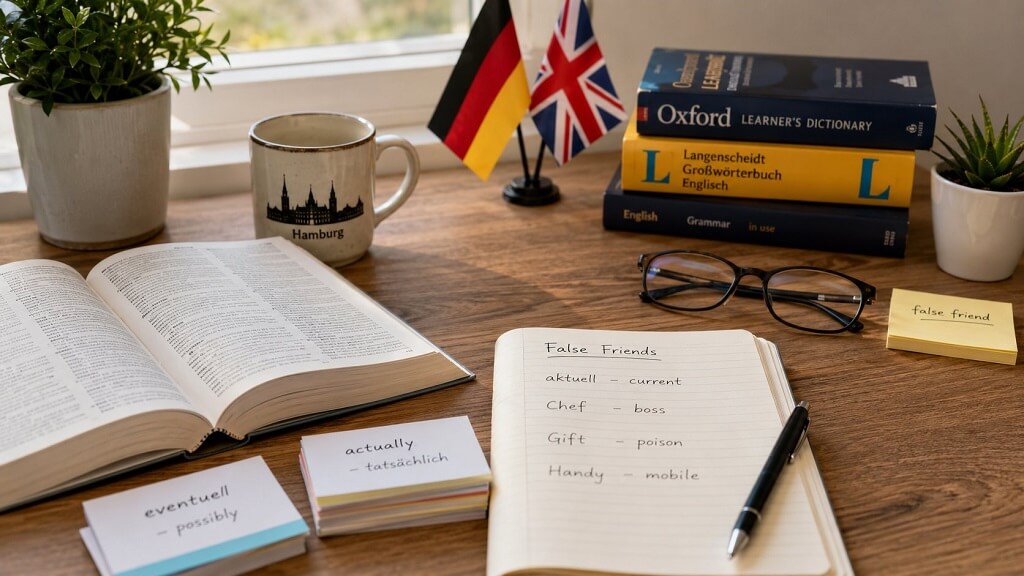
False friends are one of the clearest reminders that looking similar and meaning the same thing are two different things entirely. For German learners, the fifteen words above cover most of the mistakes that come up in daily conversation, business writing, and casual reading. Keeping a short mental list of them, especially Gift, Bekommen, and Billion, will save you from a surprising number of confusing moments.