

Publishing a book has never offered more options. Authors, small publishers, and independent businesses can launch a title through Amazon KDP without ordering inventory, or invest in a traditional print run and manage stock themselves.
Each approach has advantages, but they differ significantly in production costs, profit margins, flexibility, and day to day operations.
Distribution is another factor that deserves attention before choosing a publishing model. Some businesses combine their own inventory with professional FBA prep services to simplify storage, labeling, and fulfillment while selling through multiple channels.
Logistics can influence profitability just as much as printing costs, especially as sales volumes increase.
Choosing the right option depends on expected demand, available budget, pricing strategy, and how much control you want over production and distribution. Understanding the strengths and limitations of each model helps avoid expensive mistakes later.
How KDP print-on-demand works?
Kindle Direct Publishing, better known as KDP, produces a print copy only after an order has been placed. The publisher uploads the interior file and cover, selects the trim size, paper, ink, and other available options, then sets a list price for each marketplace.
Amazon collects the payment, prints the book, packs it, ships it, and manages customer service for orders made through its platform. The publisher does not receive or handle the physical copy. Earnings are calculated from the list price, the applicable royalty rate, and the printing cost.
Amazon states that KDP print royalties can reach 60 percent, depending on the book price and marketplace. Printing expenses are then deducted from that amount. KDP calculates printing costs using factors such as page count, trim size, ink type, format, and the marketplace where the order is placed.
Its official printing cost and royalty calculator provides a more reliable estimate than a general formula because rates differ across formats and countries.
Authors preparing their first title can also read our guide on how to publish a book on Amazon KDP. It covers the main setup steps for Kindle and print editions.
How a private print run works?
A private print run involves ordering a fixed quantity from a commercial printer. The order may contain 100, 500, 1,000, or several thousand copies. The publisher pays for the full production batch and takes ownership of the finished books.
Several printing methods may be available. Short digital runs work well for modest quantities because setup is faster and less expensive. Offset printing generally becomes more attractive at higher volumes. It requires more preparation, but the unit cost can fall sharply when the same book is produced in large numbers.
The publisher must arrange delivery from the printer and decide where the books will be stored. Every sale then requires picking, packing, shipping, stock tracking, and return handling. A distributor or fulfillment partner can take over much of that work, but each service adds another cost.
KDP and private printing compared
| Factor | KDP Print-on-Demand | Private Print Run |
| Upfront printing payment | No bulk inventory payment | Full batch usually paid before delivery |
| Unit production cost | Relatively high and tied to KDP rates | Often lower as order quantity increases |
| Inventory ownership | No inventory held by the publisher | Publisher owns all printed copies |
| Storage | Not required for Amazon orders | Required at home, in an office, or in a warehouse |
| Amazon fulfillment | Included for KDP orders | Must be arranged separately |
| Packaging control | Limited | Full control |
| Special finishes | Limited to available KDP options | Far more options through specialist printers |
| Unsold stock risk | Very low | Publisher carries the risk |
| Direct-sales margin | Limited by print cost and platform deductions | Can be much higher after inventory is paid for |
Upfront cost and financial risk
KDP has a clear advantage when the available budget is small. An author can prepare the files, order a proof, and make the book available without purchasing a large quantity. Printing expenses are deducted after a customer buys a copy.
That structure is useful for new authors, experimental titles, regional subjects, poetry, specialist manuals, and books with uncertain demand. A book can remain available without a garage or warehouse filled with copies that may never sell.
A private print run requires a larger commitment. The printer may require full payment or a deposit before production begins. Freight, pallets, customs charges, insurance, storage, and receiving fees may also apply. Money remains tied up in stock until customers purchase the books.
A low unit quote can therefore be misleading. A publisher should calculate the total landed cost, not only the printer invoice. Landed cost includes production, transport, import charges where applicable, storage, handling, packaging, and losses caused by damaged or unsellable copies.
How KDP royalties affect the margin?
KDP does not pay the entire difference between the retail price and printing cost. The royalty calculation begins with the applicable percentage of the list price. Printing cost is deducted afterward.
Amazon presents the basic calculation as:
Royalty = royalty rate multiplied by list price, minus printing cost
For example, assume a paperback is priced at $15 and qualifies for a 60 percent royalty rate. Sixty percent of $15 is $9. If the printing cost is $4.60, the estimated royalty would be $4.40 before taxes or other business expenses.
| Example item | Amount |
| Paperback list price | $15.00 |
| Amount at a 60 percent royalty rate | $9.00 |
| Example printing cost | $4.60 |
| Estimated royalty | $4.40 |
The figures above are illustrative. Actual printing costs depend on current KDP rates and the specifications of the book. Amazon explains its paperback pricing structure on the official print book pricing page.
List price also matters because KDP royalty percentages can change at different price levels and in different marketplaces. A lower retail price may improve affordability but reduce earnings more than expected. Our Amazon KDP pricing guide explains how price, royalties, and printing deductions work together.
How a private print run changes the margin?
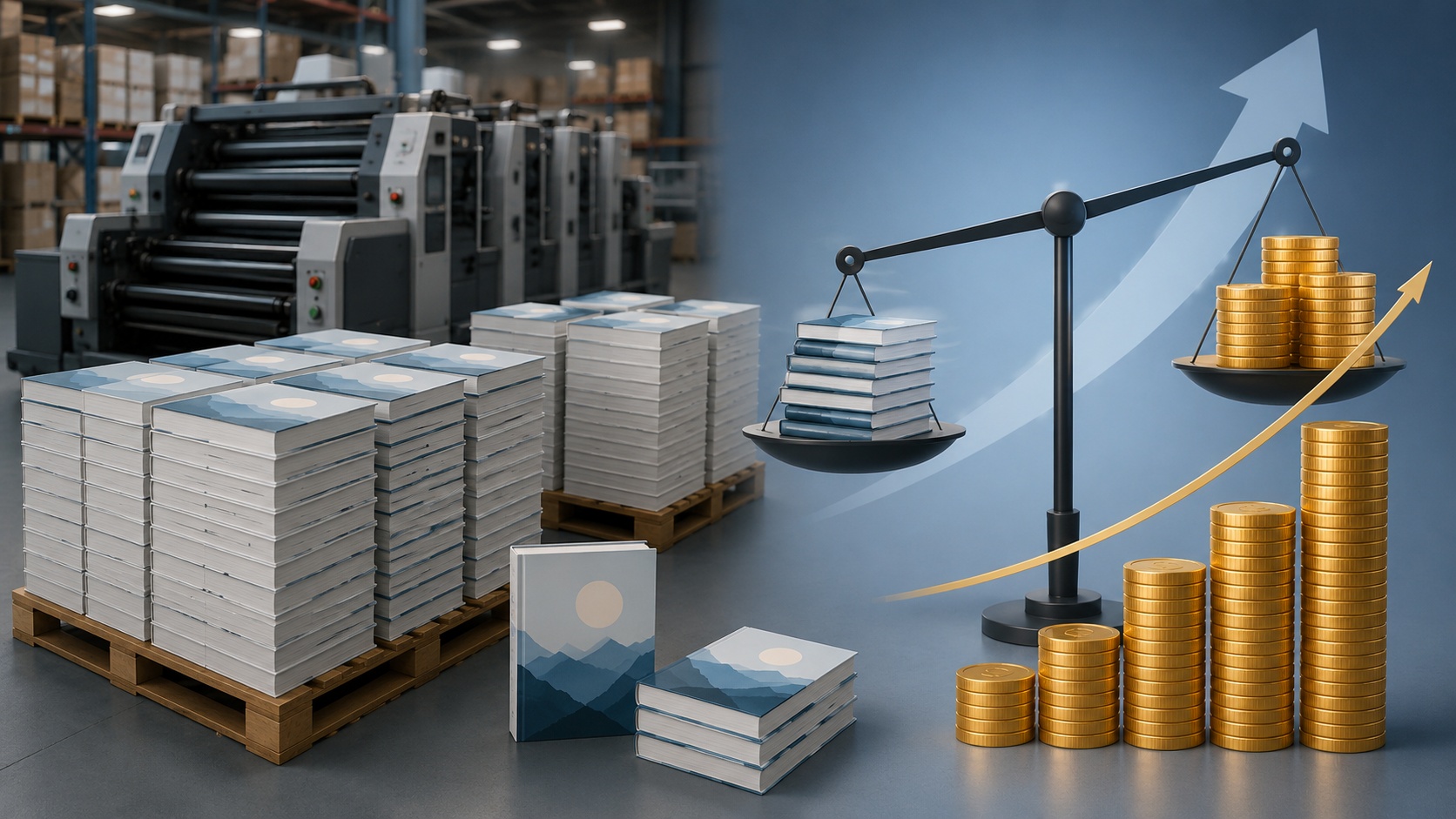
Bulk printing can create a much larger gross margin, particularly for direct sales. Suppose a publisher orders 1,000 paperbacks at a landed cost of $3 per copy and sells each one directly for $15. The initial gross difference is $12 per book.
That $12 is not pure profit. Payment processing, packaging, postage, warehouse handling, advertising, returns, and taxes still need to be deducted. Even so, a successful direct-sales operation may retain more per copy than a print-on-demand sale.
| Illustrative direct-sale calculation | Amount per book |
| Retail price | $15.00 |
| Landed printing cost | $3.00 |
| Packaging and handling | $1.25 |
| Payment processing | $0.75 |
| Marketing allocation | $2.00 |
| Estimated contribution before overhead and tax | $8.00 |
Margins become narrower when books are sold through wholesalers or bookstores. Retailers may expect a substantial discount from the list price. Distributors may take an additional share. Returns can create another expense, particularly when damaged books cannot be sold again.
Bookstores, libraries, schools, and events change the calculation
KDP works particularly well when Amazon is the main sales channel. A private run becomes more attractive when a publisher has access to other buyers.
Author events can produce strong margins because customers purchase directly. Schools, companies, associations, and conference organizers may place bulk orders.
Independent bookstores may accept local books, although they normally expect trade discounts and may request returnable terms.
Publishers seeking broader retail distribution should also consider ISBN ownership. A free KDP ISBN is convenient, but authors who want their own publishing imprint and wider control may prefer to purchase an ISBN from the official agency in their country.
Our guide on ISBN requirements for self-publishing explains the main differences.

Private printing offers more production choices
KDP supports common paperback and hardcover formats, but its options are standardized. That limitation keeps the process efficient. It can also restrict books that depend on unusual materials or presentation.
- Custom trim sizes
- Several paper weights and finishes
- Cloth or specialist binding
- Foil stamping
- Embossing and debossing
- Spot varnish
- French flaps
- Gatefold pages
- Ribbon markers
- Slipcases and presentation boxes
- Custom inserts and bundled products
Those options matter for art books, photography collections, premium cookbooks, gift editions, journals, workbooks, and collector releases. They also raise production complexity.
Every special feature should support the audience and price rather than exist only for decoration.
Final thoughts
KDP print on demand and traditional print runs solve different business problems. Print on demand minimizes financial risk, eliminates inventory management, and allows books to reach readers quickly.
Traditional printing requires greater investment but offers stronger margins, broader production options, and more control over distribution.
The best choice depends on expected sales volume, available budget, publishing goals, and long term growth plans. Many successful publishers eventually combine both strategies, using each where it delivers the greatest value.