
Traffic generation and pipeline generation represent two different but connected parts of revenue growth for tech companies.
Traffic only matters when it serves a purpose: attracting qualified prospects who can move into the revenue pipeline instead of producing empty page views.
Competitive categories such as HR tech and eLearning demand more than generic acquisition tactics. Education-first buying cycles, multi-stakeholder decision groups, long evaluation periods, and credibility requirements shape how demand must be built.
Successful growth requires traffic systems built specifically to feed pipeline outcomes.
Traffic Generation Foundations
Early-stage growth for tech companies depends on attracting the right visitors, not simply increasing traffic volume.
Strong traffic systems create the first contact point with future buyers and shape how prospects begin evaluating solutions.
Effective acquisition focuses on relevance, intent, and long-term pipeline contribution.
Defining Traffic Generation
Traffic generation refers to attracting visitors who can enter a conversion path and progress toward becoming leads, opportunities, and revenue.
High-performing traffic programs focus on purposeful entry points that match buyer intent. Prospects arriving through meaningful search queries or educational topics are far more likely to convert than visitors clicking casually.
Top-of-funnel activity supports pipeline growth only when it pulls in people actively searching for solutions.
Signals that traffic quality is strong often include:
- Repeat engagement with product-relevant content
- Visits to pricing, demo, or comparison pages
- Content downloads tied to known pain points
Lead generation should not focus on collecting emails for volume. Lead generation works best when it attracts high-quality prospects with an authentic interest in solving a specific business problem.
Qualification begins at the traffic level, long before a form fill or demo request happens.
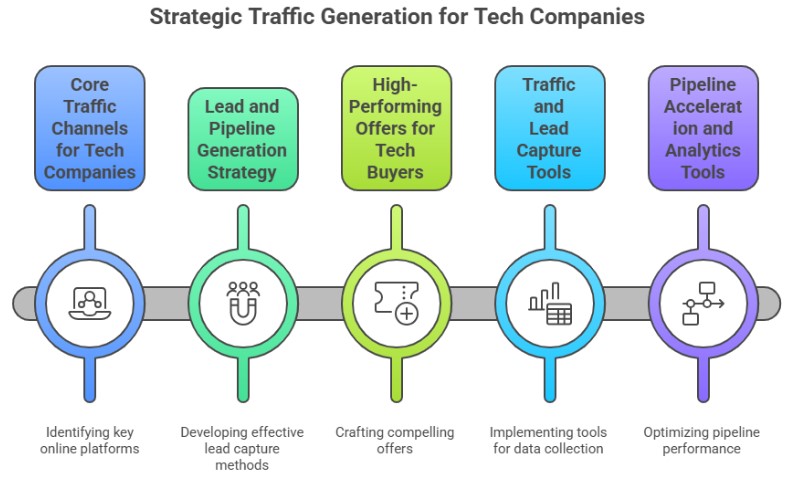
Core Traffic Channels for Tech Companies
Multiple channels contribute to sustainable demand generation, yet tech companies benefit most when channel selection reflects how buyers research, compare, and validate solutions.
HR tech and eLearning buyers often require extended evaluation and credibility signals before entering sales conversations.
Content and SEO

Content remains one of the most effective inbound traffic sources for tech companies.
Educational assets such as blogs, practical guides, templates, checklists, whitepapers, and webinars capture attention early in the buying process.
Content performs best when it answers real buyer questions such as implementation concerns, ROI validation, or compliance requirements.
Formats that consistently generate qualified inbound interest include:
- Benchmark reports for industry comparison
- Step-by-step templates that support internal planning
- Webinar sessions that address operational challenges
SEO platforms such as Ahrefs and Semrush support high-intent traffic acquisition by identifying demand signals, keyword opportunities, and content gaps.
Organic search performs especially well in segments where buyers research extensively before engaging sales.
Paid Channels
Paid acquisition supports faster pipeline creation when campaigns align with high buyer intent.
Paid search and paid social campaigns generate targeted traffic when aligned with strong intent actions such as trial signups or demo requests.
Bitmedia serves as a specialized ad network delivering targeted audiences for modern digital businesses, especially in crypto, fintech, and Web3 verticals, helping drive high-quality, intent-rich traffic through banner, native, and other ad formats.
Performance improves significantly when paid messaging maps directly to buyer readiness. Campaigns targeting research-stage prospects should lead with education rather than conversion pressure.
Paid placements work well in situations where buyers already show comparison intent, including:
- Vendor directory searches
- Sponsored industry content placements
- Retargeting sequences for evaluation-stage visitors
PPC placements in directories or sponsored content packages reach buyers already comparing vendors and researching solutions.
Paid acquisition succeeds when offers match buyer intent rather than pushing aggressive conversion too early.
Referrals and Partnerships

Partnership traffic delivers high trust and strong conversion potential, especially in credibility-dependent tech sectors.
Referral traffic grows through co-marketing agreements, partner ecosystems, and industry-specific listings.
Partner directories and joint campaigns introduce solutions through trusted third-party channels, improving lead quality.
Co-marketing activity often generates pipeline-ready prospects through:
- Integration partner promotion pages
- Joint webinar campaigns
- Shared industry newsletter placements
Partnership activity works well in HR and eLearning markets where credibility influences buying behavior.
Events and Communities
Community-led acquisition supports long buying cycles by creating consistent visibility and repeat contact points.
Webinars, live troubleshooting sessions, and community-based forums attract niche audiences while building authority.
Interactive formats help prospects engage before committing to direct sales conversations. Technical buyers often prefer peer engagement and practical problem-solving early in evaluation.
Community engagement creates repeat touchpoints that support long buying cycles and ongoing education needs.
Common high-impact community approaches include:
- Product troubleshooting sessions
- Expert-led Q&A events
- Industry-specific forums for peer exchange
Event-based acquisition performs well when paired with follow-up nurture systems.
Lead and Pipeline Generation Strategy
Traffic alone does not create revenue.
Growth depends on how well prospects convert into qualified leads and then progress into a measurable pipeline.
Tech companies succeed when lead generation and pipeline development operate as connected systems rather than isolated marketing activities.
Lead Generation Fundamentals
Lead generation combines a structured process with creative offer positioning.
Complex tech categories such as HR software and eLearning platforms require education-heavy content because buyers evaluate deeply before converting.
Evaluation cycles include multiple stakeholders, internal justification, and extended review periods. Lead generation must support these realities through proof-based assets and intent-focused engagement.
Credibility-oriented assets such as expert insights, benchmarks, and proof-based resources increase conversion readiness.
Offers that consistently raise lead quality include:
- Industry benchmarks tied to buyer priorities
- Case-based proof of measurable outcomes
- Templates that help internal teams plan adoption
Successful programs attract prospects who match ICP criteria and show active intent.
Pipeline-Focused Campaigns
Pipeline generation focuses on qualified opportunities that convert into revenue rather than lead volume alone.
Pipeline-building requires coordination between acquisition, nurture, and sales readiness. Dealfront frames pipeline development as relationship building rather than funnel filling.
Marketing teams should connect campaign activity directly to SQL creation and closed-won outcomes.
Key campaign systems succeed when tied to measurable pipeline contribution such as:
- Opportunity creation rate
- Revenue sourced per campaign
- Sales cycle acceleration metrics
Offers That Drive Conversions
Offer design determines conversion performance across every channel.
Tech buyers respond best to resources that reduce risk, build confidence, and support justification efforts across stakeholder groups.
High-Performing Offers for Tech Buyers
Tech buyers respond best to offers that educate, validate, and reduce evaluation risk.
Whitepapers and detailed research reports build authority and trust.
Webinars and expert workshops provide practical problem-solving insight.
Direct-response offers that accelerate qualification include:
- Free trials tied to clear onboarding support
- Pilot programs with defined evaluation criteria
- Demo experiences tailored to use-case needs
ROI tools and templates help stakeholders justify budget approval internally.
Offer Alignment by Funnel Stage
Offer effectiveness depends on matching buyer readiness rather than forcing premature conversion.
Top-of-funnel offers focus on education and early curiosity:
- Educational eBooks
- How-to guides
- Benchmarking reports
Mid-funnel offers support evaluation and comparison:
Case studies provide proof tied to outcomes. Use-case libraries clarify applicability. Solution comparison assets help buyers narrow vendor choices.
Bottom-funnel offers accelerate conversion:
- Live demos
- Free trials
- Personalized consultations
Offer selection should match buyer readiness instead of forcing premature sales engagement.
Tools and Technology Stack
@mobysiddique 💥 SEMrush vs Ahrefs: Which SEO Tool Should You Buy? If you had to pick one, SEMrush edges ahead for value and functionality. 🚀 Here’s why SEMrush wins: 🧠 Domain analytics for keyword + competitor research 🔗 Link building tools to grow your backlinks 🛠️ Site audit to clean up broken links + pages 🎯 Keyword Magic Tool to build content clusters from theme buckets Perfect for marketers who want strategy, insights, and technical SEO, all in one place. #SEOTools #SEMRushVsAhrefs #MarketingTools #DigitalMarketingTips #MarketingMentors
♬ original sound – Moby @ RedPandas Digital – Moby @ RedPandas Digital
Tech demand generation requires systems that connect acquisition, conversion, nurture, and pipeline reporting.
Tool selection matters most when aligned with buyer intent signals and measurable pipeline outcomes.
Traffic and Lead Capture Tools
SEO and content platforms such as Semrush and Ahrefs attract qualified organic visitors by mapping buyer intent and identifying search demand.
Landing page platforms such as Unbounce convert visits into leads through optimized forms, messaging, and testing.
Conversion infrastructure improves when supported by:
- Intent-based landing experiences
- Continuous A/B testing of offers
- Segmented form paths tied to buyer role
Traffic generation succeeds when acquisition and capture operate as one integrated system.
Lead Nurturing and Marketing Automation

Marketing automation platforms such as HubSpot, Marketo, and ActiveCampaign support workflows, scoring models, segmentation, and personalized outreach.
Conversational engagement tools such as Intercom and Drift increase conversion by engaging visitors at decision moments.
Automation becomes critical in long buying cycles where multiple touches are required before sales readiness.
Workflows that support pipeline progress often include:
- Lead scoring tied to behavioral activity
- Segmentation by industry and company size
- Personalized nurture aligned with buyer stage
Pipeline Acceleration and Analytics Tools
CRM and sales engagement platforms such as Salesforce and Outreach organize opportunity stages and pipeline progression.
Account intelligence tools such as 6sense and Clearbit support prioritization and targeting based on intent and account signals.
Systems supporting pipeline acceleration typically include:
- Opportunity tracking tied to campaign source
- Account prioritization based on intent surges
- Visibility into sales engagement activity
Pipeline acceleration works best when marketing execution connects directly into CRM opportunity reporting.
Summary
Traffic generation must stay intentional and qualified, focused on prospects likely to convert into pipeline.
Pipeline-focused campaigns paired with offers aligned to buyer stage increase conversion outcomes significantly.
Measurement frameworks grounded in pipeline value and revenue impact ensure marketing investment supports business growth rather than vanity metrics.