
Linear algebra marks a real turning point in a student’s math life. For many learners, it becomes the first course where solving equations is no longer the finish line. Explanation, interpretation, and structure suddenly matter just as much as calculation.
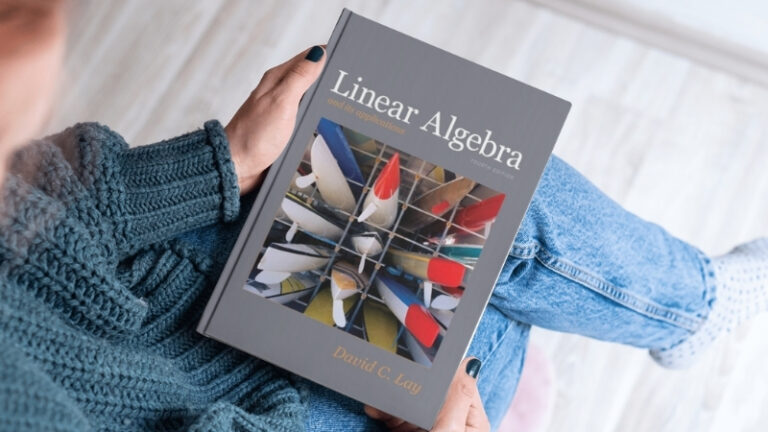
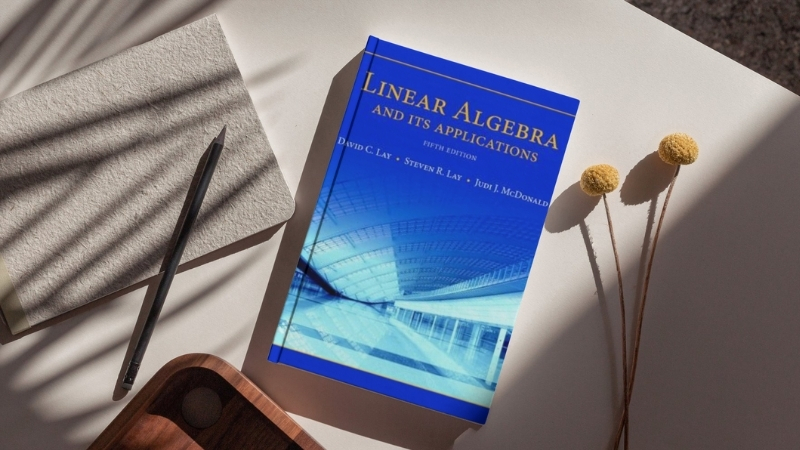
A well-designed introductory textbook can make that shift feel challenging but manageable. Linear Algebra and Its Applications, authored by David C. Lay and later editions co-written with Steven R. Lay and Judi J. McDonald, has earned a reputation for playing that role well.
Across decades of use in universities worldwide, the Lay text has been positioned as a bridge rather than a filter. The approach favors matrices early, leans heavily on examples, and keeps applications close at hand.
Let’s take a look at why that approach often works for students arriving from high school math, where friction can still appear, and how to use the book effectively as a stepping stone into university-level thinking.
Why Linear Algebra Feels Like A New Language After High School

High school algebra builds fluency through repetition. Simplify expressions. Solve equations. Plot graphs.
Success often comes from mastering a sequence of steps. Introductory linear algebra keeps those skills in play but asks for several new habits at the same time.
Early university linear algebra expects students to think in objects such as vectors, matrices, subspaces, and transformations rather than single-number expressions, accept multiple representations, and build intuition with diverse explanations.
For additional theory and solved problems that reinforce these transitions, students can explore Qui Si Risolve, a platform with worked examples and clear step-by-step reasoning.
A solid bridge text does not remove abstraction. It introduces abstraction in stages, allowing intuition to grow while computation remains familiar.
What the Lay Textbook Tries to Do Pedagogically
View this post on Instagram
Before looking at specific chapters or examples, it helps to see the instructional logic behind the Lay textbook and how its structure is intentionally shaped to guide students from familiar algebra into university-level linear thinking.
Starting With Familiar Ground
The Lay approach usually opens with systems of linear equations and matrix notation.
Systems already feel familiar to students coming from secondary school, yet matrices introduce a powerful new way to organize and manipulate information.
That opening choice lowers the initial barrier without watering down the mathematics.
Delaying The Abstract Wall Without Avoiding It
Pearson, the publisher, openly acknowledges a common student experience. Comfort early in the course often gives way to confusion once vector spaces and general definitions arrive.
The Lay structure anticipates that moment by introducing major ideas first in concrete settings, often inside ℝⁿ, before returning to them in broader and more formal language later.
Emphasizing Algorithms And Applications
A review hosted by the Mathematical Association of America describes the book as algorithm-focused and application-driven, with enough breadth for a full introductory course and additional topics beyond.
That emphasis mirrors how many departments actually teach first linear algebra: computation supported by concept-building, followed by selective depth.
Why the Book Works As a Bridge
The book succeeds as a bridge because it meets students where their high school math habits still work, then steadily reshapes those habits into the kind of conceptual thinking university mathematics demands.
Early Chapters Reward Effort Quickly
Motivation matters during transition periods. A matrix-first structure offers quick feedback. Row reduction, solution sets, and consistency checks reward practice and precision.
Many worked examples allow students to see progress early, which builds confidence before definitions become more demanding.
Algebra And Geometry Stay Connected
One recurring strength involves translation between symbolic definitions and geometric meaning.
- Span becomes a collection of reachable directions
- Linear independence becomes freedom from redundancy
- Column space describes all possible outputs of a transformation
- Orthogonal projection becomes a closest-point problem
Publisher materials highlight geometric interpretation as a guiding design feature. Graphs disappear beyond three dimensions, yet visualization remains central through careful geometric language.
Repetition With Variation Builds Maturity
University mathematics relies on seeing one object from several angles. Lay repeatedly cycles concepts through different forms:
- Systems, matrices, and vector equations
- Solution sets, null space, and column space
- Computation followed by interpretation
That repetition with variation prepares students for later proof-based courses, where flexibility of viewpoint becomes essential.
Orthogonality And Least Squares Receive Proper Weight
Least squares appears as a core topic rather than a footnote. Orthogonality supports both geometry and numerical stability, making it central to modern applications.
Students see how linear algebra responds when real-world data refuse to cooperate with exact solutions.
Why The Bridge Matters In 2026

Linear algebra now sits at the foundation of many academic and professional pathways. Engineering, economics, computer science, data science, graphics, and optimization all rely on vector-based thinking.
The National Academies of Sciences, Engineering, and Medicine identifies linear algebra as part of the essential toolkit for long-term success in data science, alongside probability, statistics, and algorithms.
Employment projections from the U.S. Bureau of Labor Statistics estimate 34% growth in data scientist roles from 2024 to 2034. Such numbers underscore the continuing relevance of linear algebra far beyond math departments.
Later editions of the Lay book reflect that reality. Chapter lists include applications connected to digital signal processing and machine learning-oriented linear models, signaling a shift toward contemporary use cases.
A Bridge Map From High School Skills To University Thinking
| High School Skill | What Lay Builds From It | University-Level Gain |
| Solving systems | Row reduction and matrix equations | Viewing solution sets as objects |
| Algebraic manipulation | Matrix algebra and inverses | Structural rules, not rote tricks |
| Coordinate geometry | Vectors in ℝⁿ, planes, subspaces | Thinking beyond 2D and 3D |
| Function-based thinking | Linear transformations | Seeing formulas as mappings |
| Dot product intuition | Orthogonality and projections | Geometry supporting computation |
| Exponential growth examples | Eigenvalues in dynamics | Long-term behavior and stability |
Coverage order varies by edition and instructor, yet Pearson’s published tables of contents consistently follow that overall arc.
Concrete Examples Showing The Bridge In Action
The real value of a bridge textbook becomes clear when abstract ideas turn into workable tools, and a few well-chosen examples show how that transition actually plays out in practice.
Inconsistent Systems Become Modeling Tools
Secondary school systems usually have solutions or none at all. University linear algebra asks a new question. When no exact solution exists, what comes closest?
Least squares answers that question by finding the vector that minimizes error. Students learn:
- Why a data vector can fall outside a column space
- How projection returns it to the closest point inside
- How normal equations encode the best fit
Materials from MIT OpenCourseWare frame least squares as a central application involving geometric decomposition. Lay’s geometric-algebraic balance helps students absorb that shift without losing footing.
Eigenvalues Gain Meaning Through Dynamics
Eigenvalues often mark the moment abstraction feels sharp. Lay introduces eigenvalues through repeated transformation and long-run behavior.
- Applying a matrix repeatedly updates a system
- Eigenvectors retain direction under that update
- Eigenvalues control growth, decay, or equilibrium
That narrative links naturally to earlier exposure to exponential growth and iterative processes.
Markov Chains Offer Accessible Probability-Based Applications
Many editions include finite-state Markov chains. Transition matrices, steady states, and long-run behavior feel concrete and computational. Probabilistic interpretation keeps motivation high while reinforcing eigenvalue concepts.
Evidence Of Real University Adoption

A bridge text must align with real classrooms. Public syllabi across universities list Lay as a primary text for standard and applied linear algebra courses.
Adoption across institutions signals manageable difficulty, appropriate topic selection, and realistic prerequisite expectations.
Where Students Can Still Struggle
Even with its student-friendly structure, certain parts of the Lay approach can slow progress, especially once definitions tighten and abstraction begins to demand more careful reading and reflection.
Breadth Can Feel Overwhelming
The MAA review notes coverage exceeding a single semester. Breadth benefits self-study but can overwhelm learners without guidance.
A practical response involves selecting a clear path: systems, matrices, vector spaces, eigenvalues, orthogonality, and then one application chapter.
Definitions Require Careful Reading
Linear algebra introduces definitions meant to scale. Subspace, basis, and independence demand precision.
Helpful habits include:
- Writing examples and non-examples for each definition
- Translating definitions into geometric language, then back
- Practicing short explanation checks
Computation Can Mask Gaps
Procedural success can hide conceptual confusion.
After calculations, strong bridge habits include:
- Describing solution sets geometrically
- Explaining inverses as reversible transformations
- Stating what space a projection lands in and why
Using Lay Effectively For Self-Study
An eight-step strategy works well:
- Check readiness with small systems and algebra basics
- Master row reduction early and accurately
- Build intuition around column space and null space
- Sketch vectors, spans, and projections weekly
- Treat linear transformations as a unifying theme
- Learn orthogonality through geometry and dot products
- Apply least squares to a small dataset
- Finish with one application chapter aligned with interest
Pairing the book with a lecture-based resource can reinforce intuition. Concept-focused material from MIT OpenCourseWare complements Lay’s example-driven style well.
Final Assessment
Linear Algebra isn’t just about matrices and vectors; it’s a key to unlocking real-world problems! I’ve selected 4 awesome books to help you master its applications. Whether you’re into coding, engineering, or data science, these reads are for you!
1. Dive into ‘Linear Algebra… pic.twitter.com/MrnduydWMs— 𝐒𝐫𝐢𝐧𝐢𝐯𝐚𝐬𝐚 𝐑𝐚𝐠𝐡𝐚𝐯𝐚 ζ(1/2 + i σₙ )=0 (@SrinivasR1729) March 31, 2024
David Lay’s linear algebra text succeeds as a bridge from high school to university because it respects both sides of that divide. Familiar problems anchor early chapters.
Algorithms provide traction. Geometry keeps meaning close. Applications justify effort. Widespread adoption confirms alignment with real courses.
Much like a clear guide on how to self-publish a book, the text breaks a complex process into manageable, logical steps that reduce uncertainty.
Progress still demands work. Active problem solving, careful reading of definitions, and regular interpretation remain essential.
For students seeking a structured path into linear algebra without being thrown directly into abstraction, Lay offers a reliable and well-tested route forward.